8447444694
 contact@stellateconsultants.com
8447444694
contact@stellateconsultants.com


India has become an increasingly important market for companies looking to expand their international footprint.
But entering India is not simply a matter of registering a company.
A successful India entry requires decisions around market strategy, ownership, entity structure, foreign investment, taxation, regulatory compliance, finance, people and ongoing operations.
Choosing the wrong structure at the beginning can create unnecessary tax exposure, compliance requirements, operational restrictions and restructuring costs later.
This is where India Entry Services become important.
For a foreign company, the objective should not simply be to establish an Indian entity. The objective should be to establish the right structure for the business you intend to build in India.
India Entry Services are a coordinated set of strategic, legal, financial, tax and operational activities that help a foreign company establish and develop its presence in India.
Depending on the business model, India entry may involve:
The exact requirements depend on factors such as the company’s country of origin, sector, ownership structure, intended activities, investment size and operating model.
Therefore, India entry should be treated as a business structuring exercise, not merely an incorporation exercise.
A foreign company may have several possible ways to establish a presence in India.
For example, depending on the circumstances, the business may consider an Indian subsidiary, joint venture, branch office, liaison office, project office or another permitted structure.
Each route comes with different considerations relating to:
Ownership → Activities → Investment → Tax → Compliance → Operations → Exit
The structure that works for a technology company may not necessarily be appropriate for a manufacturing business.
Similarly, a company that wants to conduct sales and generate revenue in India may have very different requirements from a company that initially wants to conduct market research or coordinate with its existing operations.
This is why the first question should not be:
“How quickly can we incorporate?”
The better question is:
“What should our India operating structure look like three to five years from now?”
The answer can influence the decisions made today.
Before establishing an entity, a company should understand the commercial opportunity it is pursuing.
This includes evaluating:
The purpose is not to create a lengthy market report for its own sake.
The purpose is to determine what the company actually needs from its Indian presence.
For example, a company may initially require only a sales and distribution operation.
Another company may need a manufacturing facility.
A technology company may want to establish an engineering and development centre.
A professional services business may need a local operating team.
Each objective can lead to a different India-entry strategy.
Once the business objective is clear, the next question is how the company should establish its presence.
Common structures considered by foreign businesses can include:
A foreign parent establishes an Indian company that it owns, subject to applicable foreign investment rules.
This can be appropriate where the company intends to build a long-term operating business in India.
A foreign company establishes an Indian business with one or more local or other strategic investors.
This can be relevant where local market knowledge, distribution, technology, capital or relationships are important to the business model.
A foreign company may establish a branch office for permitted activities, subject to applicable regulatory requirements.
This structure is different from establishing a separate Indian subsidiary and should be evaluated based on the activities the business intends to undertake.
A liaison office may be considered where the company’s activities are limited to permitted liaison and communication functions rather than carrying on a revenue-generating business in India.
In certain circumstances, a foreign company executing a specific project in India may consider a project office structure.
The appropriate route depends on the purpose and scope of the Indian operation, rather than simply the preference of the parent company.
Foreign investment is one of the most important areas to evaluate before incorporation.
India has sector-specific foreign investment rules. Depending on the sector and proposed activity, investment may be permitted under the automatic route or may require government approval.
Other considerations can include:
Therefore, a company should determine the applicable foreign investment framework before finalising its structure and funding plan.
A structure that looks commercially attractive may require modification if the proposed activity has specific foreign investment restrictions.
Entity selection is one of the most consequential decisions in the India-entry process.
For many foreign companies, an Indian private limited company may be considered for a long-term operating presence.
However, that does not mean it is automatically the right answer for every business.
The decision should consider:
What exactly will the Indian operation do?
Who will own the Indian entity and in what proportion?
How will the Indian operation be funded?
What are the potential Indian tax implications of the proposed structure and transactions?
What statutory, regulatory and reporting obligations will arise?
Will the company hire employees, lease premises, maintain inventory or enter contracts locally?
Will the Indian entity eventually manufacture, export, acquire another business or raise local capital?
What happens if the company eventually restructures or exits the Indian market?
The right entity is therefore not necessarily the entity that is easiest to incorporate.
It is the entity that best fits the company’s current objective and future operating model.
Once the structure has been determined, the incorporation process can begin.
For an Indian company, this can involve matters such as:
However, incorporation should be viewed as one milestone within the India-entry journey, rather than the completion of the process.
A company can have an incorporated entity and still not be operationally ready to conduct its intended business.
Once the Indian structure is established, the company needs an appropriate financial framework.
This can include:
For foreign-owned businesses, the movement of funds between the parent and Indian entity should be planned carefully.
Capital investment, intercompany payments, loans, royalties, management fees and other transactions can have different regulatory and tax implications.
A well-designed financial process helps prevent compliance from becoming an afterthought.
Entering India creates an ongoing compliance framework.
Depending on the business, this can involve areas such as:
The applicable requirements depend on the company’s activities and structure.
For example, a company importing goods into India can have very different compliance requirements from a company providing technology services through an Indian development centre.
This is why compliance should be mapped to the actual operating model.
A legally incorporated entity does not automatically create a functioning business.
The company may also need to establish:
This is where the India entry strategy needs to connect with the company’s broader global operating model.
For example:
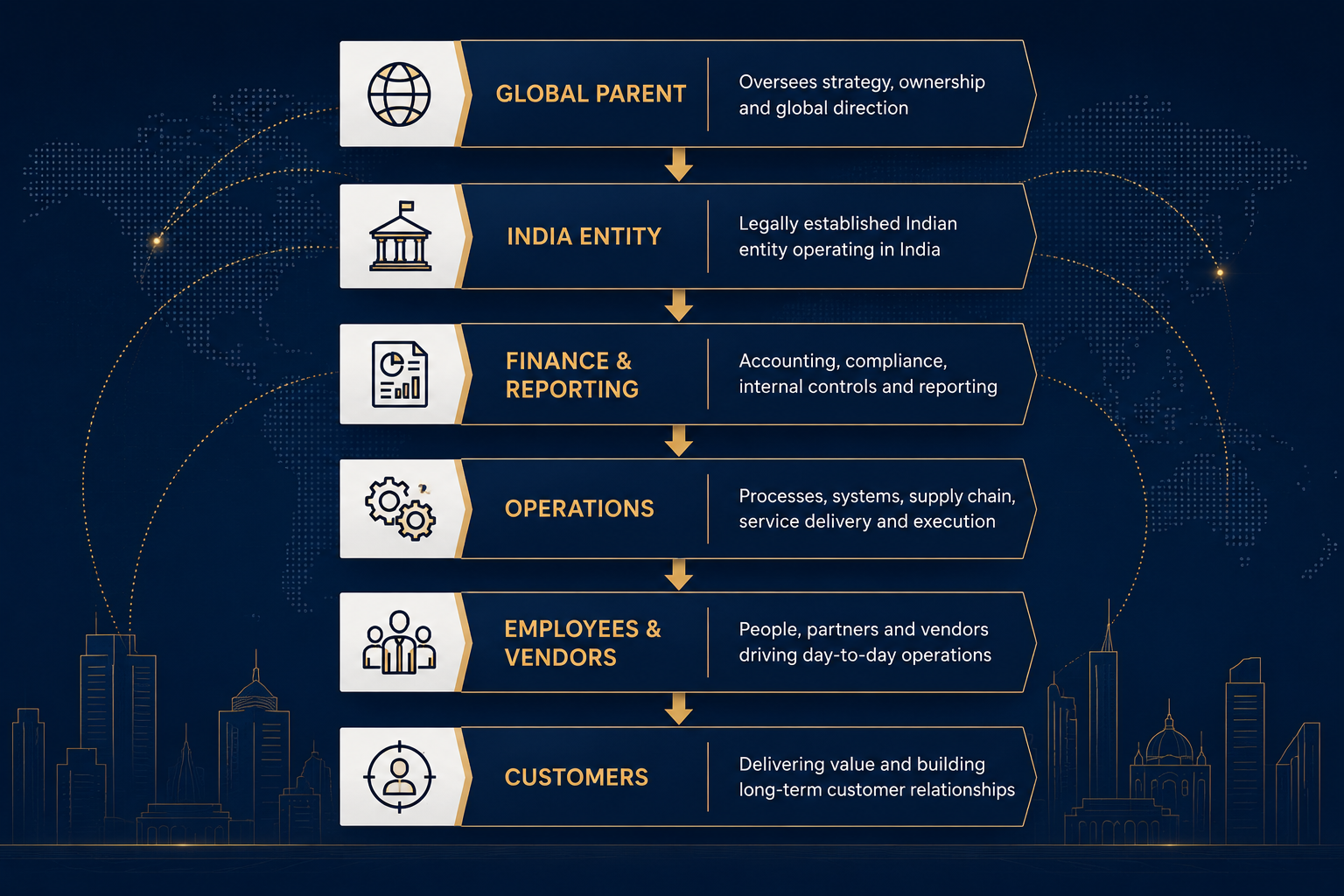
A clear allocation of responsibilities between the parent company and Indian entity can help reduce operational ambiguity later.
India entry does not end once the company receives its incorporation certificate.
The Indian operation will have continuing obligations.
These may include:
The precise obligations depend on the company’s structure and activities.
This is why companies entering India should build compliance into the operating model from the beginning rather than attempting to address it after the business has already started operating.
The company decides to incorporate before determining what the Indian entity actually needs to do.
Better approach: Define the business objective first.
The easiest structure to establish may not be the most appropriate structure for the intended business.
Better approach: Evaluate ownership, activities, investment, tax, compliance and future growth together.
Foreign investment requirements can influence the structure and funding strategy.
Better approach: Evaluate the applicable FDI framework before finalising the structure.
Foreign parent companies may later charge the Indian entity for services, technology, management or other arrangements.
These transactions can create tax, transfer pricing and regulatory considerations.
Better approach: Design the intercompany framework early.
The cost of registering an entity is only one component of the cost of entering India.
Companies should also consider:
The more important question is not:
“How much does incorporation cost?”
It is:
“What will it cost to establish and operate the Indian business properly?”
Before commencing operations, a foreign company should consider whether it has addressed the following:
India entry should not be treated as a collection of disconnected registrations and compliance activities.
At Stellate, the approach is to look at the India business as a complete operating model.
The process can be structured across:
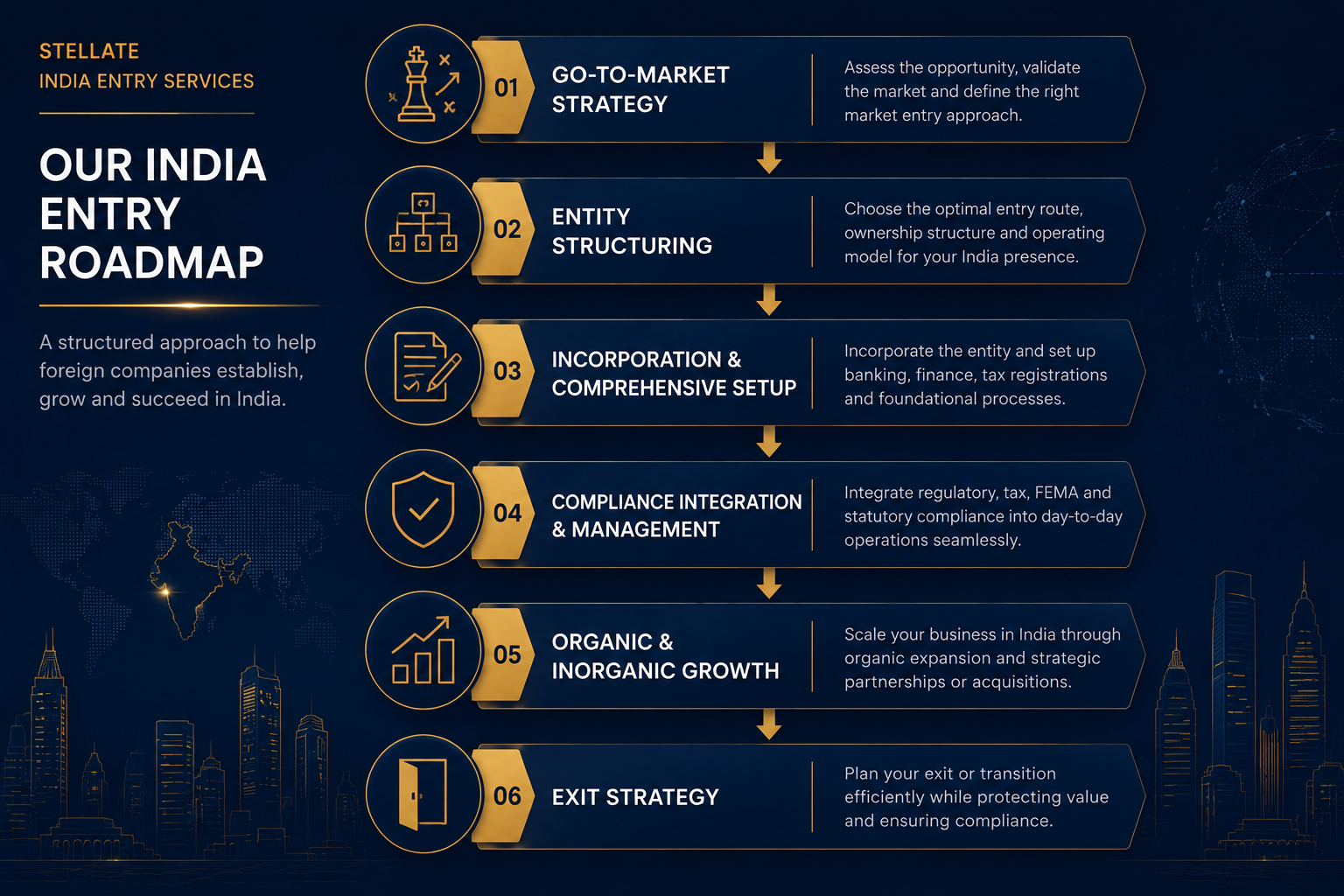
This approach allows the company to consider not only how to enter India, but also how the Indian business can evolve after entry.
The objective is to create an India structure that is aligned with the company’s commercial goals, ownership model and long-term growth plans.
India Entry Services cover the strategic, structuring, incorporation, tax, regulatory and operational considerations involved in establishing and developing a foreign company’s presence in India.
Not necessarily. The appropriate structure depends on the activities the company intends to undertake, applicable regulations, ownership requirements and business objectives.
There is no single structure that is best for every foreign company. The appropriate structure depends on factors including business activities, ownership, sector, investment requirements, tax considerations and long-term plans.
The timeline varies depending on the entry route, sector, approvals, incorporation requirements, banking, registrations and operational setup. Incorporation itself should not be confused with being fully operational in India.
Foreign ownership is permitted in many sectors, subject to applicable foreign investment rules, sectoral conditions and entry routes.
No. Incorporation is only one component. A comprehensive India-entry strategy can also involve market assessment, entity structuring, FDI, tax, FEMA, banking, accounting, employment, compliance and operational planning.
India offers significant opportunities for companies looking to establish or expand their international operations.
But entering a market of India’s scale and regulatory complexity requires more than setting up a legal entity.
The decisions made before incorporation can influence taxation, compliance, ownership, funding, operations and future growth.
A successful India entry therefore begins with a clear question:
What should our Indian business look like not just on the day it is incorporated, but several years after it enters the market?
That is the foundation of a well-planned India entry strategy.
Stellate helps foreign companies evaluate, structure and establish their India presence from market entry strategy and entity structuring through incorporation, compliance, growth and eventual exit.
Ready to evaluate your India entry strategy?
Connect with Stellate to discuss your proposed India operations.
 Monday – Friday 10.00 – 5:00 pmSaturday 10.00 – 01:00 pm
 Sunday closed